 |
| Home | Contact |
Levomenthol or L-menthol and Menthol USP BP Ph Eur Grade Supplier Exporter Manufacturers' Representative |
| Email: info@ammol.org |
| Call Toll Free +1-855-552-6665 Toll Free: 1-855-55-AMMOL |
Quick Links to Products: Ammonium Carbonate | - Axitinib | - Betaine Hydrochloride | - Calcium Ascorbate | - Copper Sulfate | - Diclofenac Sodium | - Etoricoxib | - Felodipine | - Glycerol Formal | - Levomenthol Suppliers | - and more -- |
Levomenthol or L-menthol and Menthol
CAS Number: 2216-51-5
Molecular Formula: C10H20O
Molecular Weight: 156.27
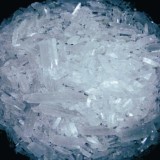
Levomenthol or L-menthol and Menthol
Menthol USP Grade Specifications
C10H20O --- 156.27
Cyclohexanol, 5-methyl-2-(1-methylethyl)- [CAS 1490-04-6].
Menthol is an alcohol obtained from diverse mint oils or prepared synthetically.
Menthol may be levorotatory (l-Menthol), from natural or synthetic sources, or racemic (dl-Menthol).
Packaging and storage: Preserve in tight containers, preferably at controlled room temperature.
Labeling: Label it to indicate whether it is levorotatory or racemic.
Identification: When it is triturated with about an equal weight of camphor, of chloral hydrate, or of phenol, the mixture liquefies.
Melting range of l-Menthol: between 41 and 44C.
Congealing range of dl-Menthol: [NOTE—Perform this test preferably in a room having a temperature below 30C and a relative humidity below 50%.] Place about 10 g of racemic Menthol, previously dried in a desiccator over silica gel for 24 hours, in a dry test tube of from 18- to 20-mm internal diameter, and melt the contents at a temperature of about 40C. Suspend the test tube in water having a temperature of 23 to 25C, and stir the contents of the tube continually with a thermometer, keeping the bulb of the thermometer immersed in the liquid. Racemic Menthol congeals at a temperature between 27 and 28C. Shortly after the temperature has stabilized at the congealing point, add a few mg of dried racemic Menthol to the congealed mass, and continue the stirring: after a few minutes the temperature of the mass quickly rises to 30.5 to 32.0C.
Specific rotation: between 45 and 51 for l-Menthol; between 2 and +2 for dl-Menthol.
Limit of nonvolatile residue: Volatilize 2 g, accurately weighed, in a tared open porcelain dish on a steam bath, and dry the residue at 105 for 1 hour: the residue weighs not more than 1 mg (0.05%).
Chromatographic purity: To pass the test.
Readily oxidizable substances in dl-Menthol: Place 500 mg of dl-Menthol in a clean, dry test tube, add 10 mL of a solution of potassium permanganate, prepared by diluting 3 mL of 0.1 N potassium permanganate with water to 100 mL, and place the test tube in a beaker of water at a temperature between 45 and 50C. Remove the tube from the bath at intervals of 30 seconds, and mix quickly by shaking: the purple color of potassium permanganate is still apparent after 5 minutes.
Organic volatile impurities: meets the requirements.
Levomenthol BP Ph Eur Grade Specifications
C10H20O --- 156.3 --- CAS 2216-51-5
Action and use: Decongestant.
DEFINITION
(1R,2S,5R)-5-Methyl-2-(1-methylethyl)cyclohexanol.
CHARACTERS
Appearance: Prismatic or acicular, colourless, shiny crystals.
Solubility: Practically insoluble in water, very soluble in ethanol (96 per cent) and in light petroleum, freely soluble in fatty oils and in liquid paraffin, very slightly soluble in glycerol.
mp: About 43C.
IDENTIFICATION
First identification: A, C
Second identification: B, D
A. Specific optical rotation.
B. Thin-layer chromatography.
C. Examine the chromatograms obtained in the test for related substances.
D. Dissolve 0.20 g in 0.5 mL of anhydrous pyridine. Add 3 mL of a 150 g/L solution of dinitrobenzoyl chloride in anhydrous pyridine. Heat on a water-bath for 10 min. Add 7.0 mL of water in small quantities with stirring and allow to stand in iced water for 30 min. A precipitate is formed. Allow to stand and decant the supernatant. Wash the precipitate with 2 quantities, each of 5 mL, of iced water, recrystallise from 10 mL of acetone, wash with iced acetone and dry at 75C at a pressure not exceeding 2.7 kPa for 30 min. The crystals melt at 154C to 157C.
TESTS
Solution S: Dissolve 2.50 g in 10 mL of ethanol (96 per cent) and dilute to 25.0 mL with the same solvent.
Appearance of solution: Solution S is clear and colourless.
Acidity or alkalinity: Dissolve 1.0 g in ethanol (96 per cent and dilute to 10 mL with the same solvent. Add 0.1 mL of phenolphthalein solution. The solution is colourless. Not more than 0.5 mL of 0.01 M sodium hydroxide is required to change the colour of the indicator to pink.
Specific optical rotation: -48 to -51, determined on solution S.
Related substances: To pass the test by gas chromatography.
Residue on evaporation: Maximum 0.05 per cent.
Racementhol BP Ph Eur Grade Specifications
C10H20O --- 156.3 --- CAS 89-78-1
DEFINITION
Mixture of equal parts of (1RS,2SR,5RS)-5-methyl-2-(1-methylethyl)cyclohexanol.
CHARACTERS
Appearance: Free-flowing or agglomerated, crystalline powder or prismatic or acicular, colourless, shiny crystals.
Solubility: Practically insoluble in water, very soluble in ethanol (96 per cent) and in light petroleum, freely soluble in fatty oils and in liquid paraffin, very slightly soluble in glycerol.
mp: about 34C.
IDENTIFICATION
First identification: A, C
Second identification: B, D
A. Optical rotation.
B. Thin-layer chromatography.
C. Examine the chromatograms obtained in the test for related substances.
D. Dissolve 0.20 g in 0.5 mL of anhydrous pyridine. Add 3 mL of a 150 g/L solution of dinitrobenzoyl chloride in anhydrous pyridine. Heat on a water-bath for 10 min. Add 7.0 mL of water in small quantities with stirring and allow to stand in iced water for 30 min. A precipitate is formed. Allow to stand and decant the supernatant. Wash the precipitate with 2 quantities, each of 5 mL, of iced water, recrystallise from 10 mL of acetone, wash with iced acetone and dry at 75C at a pressure not exceeding 2.7 kPa for 30 min. The crystals melt at 130C to 131C.
TESTS
Solution S: Dissolve 2.50 g in 10 mL of ethanol (96 per cent) and dilute to 25.0 mL with the same solvent.
Appearance of solution: Solution S is clear and colourless.
Acidity or alkalinity: Dissolve 1.0 g in ethanol (96 per cent) and dilute to 10 mL with the same solvent. Add 0.1 ;mL of phenolphthalein solution. The solution is colourless. Not more than 0.5 mL of 0.01 M sodium hydroxide is required to change the colour of the indicator to pink.
Optical rotation: -0.2° to + 0.2°, determined on solution S.
Related substances: To pass the test by Gas chromatography.
Residue on evaporation: Maximum 0.05 per cent.
Please visit SDS Safety Data Sheet of Levomenthol or L-menthol and Menthol Suppliers.
American Molecules, also known as ammol.org is a distributor, supplier and manufacturers' representative of all types of Pharmaceuticals, Functional Ingredients, Excipients and Specialty Chemicals in Texas USA. Our principals manufacture supply and export USP NF BP, Ph Eur, etc grades of chemicals pure and reagent grade, mineral fortifiers, FCC food grade. Tailor made particle size and customized specifications are offered. The principal's facility is having one or more of the certifications like FDA approval and GLP, cGMP, ISO9001, ISO14001, ISO/IEC 17025, ISO22000, FSSC 22000, ISO45001, FSSAI, Kosher, HALAL, COPP, WHO-GMP certified and Written Confirmation (WC) for export to Europe is available. The manufacturers suppliers and exporters observe WHO Good Manufacturing Practices and Good Laboratory Practices.

Suppliers and Manufacturers' Representative:
9910 Bent Oak Dr
Houston, TX 77040, USA
Call Toll Free: 1-855-55-AMMOL 1-855-552-6665
Email: info@ammol.org